
Celestial Pablum #8: Slacker
Is withdrawing in disgust the same thing as apathy?

Back after a longer-than-expected hiatus!
The following is an expanded version of some thoughts I shared on Slacker (1990) at the Low Cinema in Ridgewood. Thanks to Nellie Kluz, whose film The Dells is playing at Anthology Film Archives June 20–22, for the invite.
Slacker (1990), Richard Linklater’s film about avoiding work in late 1980s Austin, Texas, is often treated as a window unto a particular generation, one whose contours were shaped by the availability of birth control, the prevalence of divorce, and the collapse of both the family wage and the naive optimism of the postwar era. But in its themes and technique, the film reaches back further, confronting political and aesthetic problems that have been pressing since at least the 1920s. Maybe that is why the film continues to resonate today, enough at least to sell out several shows and earn an extended run at New York’s fun new theater.
For me, Slacker is mostly a film about anarchism. Looked at this way, the central moment in the film is when a man, in one of the series of serendipitous encounters that structure the film, encounters two women working to construct an abstract representation of the menstrual cycle in the driveway of their dilapidated ranch house. One of the women offers the man a draw from an Oblique Strategies deck of the kind made famous by Brian Eno, whose first message to young artists, famously, is “try not to get a job.” The card he pulls reads: “withdrawing in disgust is not the same thing as apathy.” This technique—withdrawal—is the one that unites every character in the film. The thesis of the card is that withdrawal—dropping out, in colloquial terms—is not a purely negative act, not an abdication. There is something there in refusal, something potentially constructive, something that creates life.
In some ways this question forms a dividing line between Marxism and anarchism. Speaking very schematically, the former tends to insist that the only way out—of capitalism, the family, the state—is through, that the notion of immediate secession from these realities is a frivolous and dangerous illusion. The collection of traditions known as anarchism has historically had a much more optimistic notion of both the possibility and the political efficacy of a withdrawal that is willful and immediate. There is an elasticity to these concepts, of course, one that is evident even across the course of Marx’s own life. As Kristin Ross emphasizes in her book on the Paris Commune, the practical abolition of the capitalist state that emerged as a result of the day-to-day exigencies of that rebellion revealed that “the working class cannot simply lay hold of the ready-made state machinery and wield it for its own purpose.” There is some kind of relationship between negativity, withdrawal, and abandonment and the construction of a new social world.
What does this question look like in an era where the infrastructure of withdrawal, whether this be the organized left formations of the workers’ movement or the varieties of welfare state that supported people in their attempts to ward off the total colonization of their lives by the imperative to work, is in a state of recession or collapse? What does withdrawal look like in an era of proletarian disorganization, one in which the social movements of the 1960s are sputtering to an exhausted halt and one that is increasingly shoveling the cumulative risks of a resurgent capitalism onto the shoulders of individuals? This in some ways is the problem confronted by Slacker.
Under these circumstances, the most reliable way to drop out is to die. Anyone who has committed sufficiently to these kinds of oppositional milieux is likely to have had friends who have chosen this option. And death is all over Slacker. In what is probably the film’s best-remembered scene, a woman (played by Teresa Nervosa of the Butthole Surfers, who along with Linklater helped coalesce a Texas-weird aesthetic for non-Texas audiences) buttonholes two acquaintances on the street to relate with joyous enthusiasm that a man has just driven his car screaming down the freeway, shooting randomly at fellow drivers, drawing massive police attention before crashing his car onto the “grassy knoll” (one of countless references to assassination in the film) and blowing his brains out, all the while laughing maniacally like Woody Woodpecker. “He’d had enough,” reflects the woman, before trying to hawk a vial that she insists contains Madonna’s pap smear, stolen from a gynecologist’s office in Los Angeles. Her story recalls a passage from the “Second Manifesto of Surrealism,” published in 1930:
The simplest Surrealist act consists of dashing down into the street, pistol in hand, and firing blindly, as fast as you can pull the trigger, into the crowd. Anyone who, at least once in his life, has not dreamed of thus putting an end to the petty system of debasement and cretinization in effect has a well-defined place in that crowd, with his belly at barrel level.1
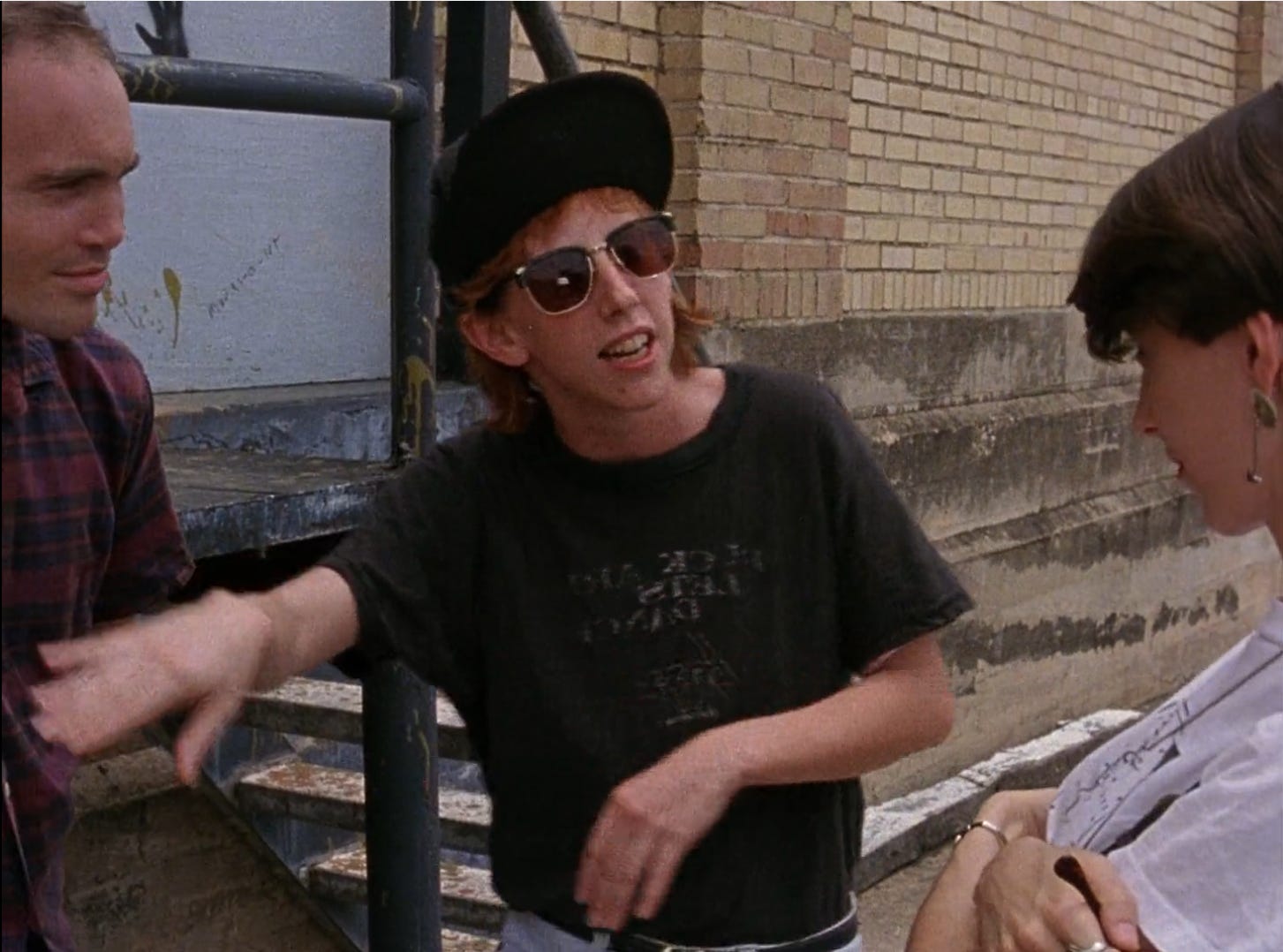
The textual underbelly of Slacker is full of these sorts of invocations, evoking some kind of shared impulse towards a concentration and acceleration of the derangement engendered by the contemporary world, culminating in spectacular violence. A strung-out burglar is thwarted by his victim, a strangely persuasive old man who invites him for a walk. The seemingly gentle greybeard turns out to be a wild-eyed anarchist who extols both the presidential assassin Leon Czolgosz and Charles Whitman, who in 1966 climbed the clock tower at the University of Texas and shot forty-eight people. Later, a man who sits all day in a room full of televisions, mainlining commercials, westerns, and images of things blowing up—a kind of one-man command center for an experiment in complete saturation by the visual image—plays a special VHS tape for his visitor. It depicts the last testament of a graduate student who will soon take his dissertation committee hostage, ending in suicide-by-cop. He’d had enough.
What unites these acts and fantasies is that they are carried out alone, in the absence of any collective organization. They evoke the situation that Jean-Paul Sartre called “seriality,” in which individuals are united by some broader social force in a way that leaves each of them disconnected from the ability to act collectively. Because seriality is perhaps the definitive condition of mass society, there are as many examples as there are life experiences under contemporary conditions. For instance, many people find their primary social connections in the workplace. But it would be difficult to say that any of them has freely chosen these particular connections—instead, the choice has been structured inescapably the will of the employer. Mass media, against which the denizens of Slacker struggle, fruitlessly, as isolated atoms, is probably the paradigmatic vehicle for imposing seriality. Social media, it should go without saying, does not alter this condition but refines and intensifies it under the guise of a democratization of the ability to influence. Keep in mind that Facebook was invented as a way for rich kids to rank the attractiveness of images of strangers.
Looked at this way, Slacker becomes an inquiry into both the potential and the risks of a strategy of serialized withdrawal, one in which suicide emerges as a kind of least common denominator. The question I’ve always asked myself around all this is whether there is some kind of satisfactory middle position. What mode and degree of dropping out is necessary to remain sufficiently “outside” the straight, capitalist world, psychically speaking, to envision some meaningful alternative to it? How can one do this while acknowledging the leaden realities of capitalism, the family, and the state, to which we are all subject, even when grace periods offered by youth and economic privilege can help delay such admissions?
Another question worth considering is whether the possibilities for this kind of individualized secession have receded as long-term economic stagnation drives up the cost of living and creates greater inequality. The obvious condition for the kind of free-floating proletarian art project depicted in Slacker is the ability to survive without working too much. But in an era where the cost of housing rises to levels unthinkable for those who tried this in the 1980s, what becomes the prospect of such an approach for those who lack independent wealth? You could call this the gentrification of dropping out. Such a condition has always been more visible in the traditionally expensive cities like New York, but a look at documentaries like Richard Sandler's Brave New York, which depicts the last gasps of the East Village in the early 90s, reveals that there have been historical moments, usually borne of social and economic crisis, where parts of New York itself have been available for such a project.
In other words, Slacker, which is often characterized as a film about the mundane, might really be one about the ways in which what is crucial gets expressed in what is mundane. Slacker feels true because it does not pretend to offer a solution, any more than those of us who have raged against the dying of the light, or whatever phrase you want to use, have ever found one under these refractory conditions.
“Second Manifesto of Surrealism,” in Manifestoes of Surrealism, trans. Richard Seaver and Helen R. Lane (Ann Arbor: University of Michigan Press, 1969), 125. Nervosa’s comment is only one of several evocations of Dada and Surrealism in the film. Later in the film, the bartender at the Continental Club, as he tries to eject straggling patrons after a long night, assuages his anxiety at encountering an attractive foreign woman with a promising if conventional art career by blustering to her that he is an “anti-artist,” before hopefully inviting her to a 4 a.m. screening of Antonioni’s Blow-Up. And as Roger Ebert pointed out in his review of Slacker, the structure of the film itself, patterned as a series of chance but not-so-chance encounters, borrows from the surrealist director Luis Buñuel. This method recalls André Breton’s notion of objective chance, which sought to theorize how encounters that appear nonsensical or inexplicable may in fact reflect unseen forces and motivations.