Announcing Battle Tours NYC
Thinking while moving, with a discount code at the end

Walking is the best way to go more slowly than any other method that has ever been found.
—Frédéric Gros, A Philosophy of Walking
Only those thoughts that come by walking have any value.
—Nietzsche
There is something different about thinking while moving. In contradistinction to the image of the scholar holed up in a hermetic alcove, my most membrane-shredding, stop-in-your-tracks realizations tend to occur while in motion—in the shower, on 4 a.m. dancefloors, sprinting up the grand staircase at Fort Greene Park. When I was in graduate school, my therapist got a job at North Central Bronx Hospital and in my loyalty, I rode the 4 train, both ways, for nearly its entire length twice a week. It wasn’t as bad as it sounds because I got more reading and thinking done on those train rides than I ever did in my apartment.
Part of me has always wanted to work outside. In graduate school I was a furniture mover, hurtling across the city in rented trucks, parking them god-knows-where, hauling clients’ air conditioners into fifth-floor walkups and explaining to them that no, the enormous couch you assembled inside your tiny living room cannot be removed from that living room without disassembling it, or that yes, your IKEA dresser more or less falls apart if you look at it, much less haul it across Brooklyn for the eighth time. I secretly loved it. Before an ill-advised stint at another city agency last year, I nearly joined the Parks Department, although I was half-scared off upon witnessing the condition of the bathrooms at Von King Park in the height of summer. These jobs put you in the city in a way that few others do, and they also put the city inside you. This is in part because they demand that you use your body, with all its senses and capacities, to situate yourself and navigate the amalgamation of buildings, vehicles, and other bodies, all moving quickly and with their own purposes, that comprise the urban environment. In the same way that they say it’s impossible to understand psychoanalysis without having experienced it (true), it’s very difficult to understand a place like New York if you’ve never been here, physically, to experience its sensory demands and opportunities.
Back when I was living even more hand-to-mouth, friends and I, brainstorming ways to avoid getting a straight job, sometimes batted around the idea of offering walking tours. It seemed like a good way to (maybe? sort of?) make a living by doing what we we were already doing anyway—wandering the city, researching its history, finding ways to read it through the built environment, talking to other people about it. We never moved on it—I had a dissertation to finish—but the idea stuck in the back of my mind as I moved through a series of post-graduation jobs that ran the gamut from meaningful, fulfilling, and badly paid to spirit-crushing, mind-blowingly exploitative and badly paid (if you ever want advice on the realities of pursuing a humanities PhD without independent wealth or an affluent partner, I’m happy to talk to you).
By far the most fulfilling work experience I’ve had since graduating has been teaching at the Brooklyn Institute for Social Research, a place I’m lucky to have fallen into, one that hits all the right notes in terms of its commitment to a rigorous, politically charged, and collective experience of knowledge-building, one that avoids many of the compromises with established power that make universities such insane places to work. Brooklyn Institute classrooms are joyous places that gather people who feel something inside themselves, however indistinct, that makes them need to know more, and who have decided to do so in a collaborative effort with other people. On good days, this combination of drive, collaboration, and camaraderie results in a kind of group charisma that leaves you dopamine-soaked and strangely hopeful about our ability to survive.
This is why, when the folks at the New York Review of Architecture, another organization doing energetic work in fostering a culture of spirited inquiry and critical panache, asked if I would consider developing a walking tour as part of their holiday pop-up, I knew I wanted to make it something like a Brooklyn Institute classroom on wheels (um, feet)—a place where people committed not only to understanding the world but changing it could gather and embark on a temporary voyage where we ask what it means to care about New York’s past and why that matters for New York’s future. The difference, this time, is that we would do it while moving. And so together we crossed Greenwich Village as the temperatures dipped towards 30℉, freezing together on the Christopher Street Pier as we discussed the way changes in the global shipping economy hollowed out the Greenwich Village of longshoremen and warehouse workers, paving the way for post-industrial transplants like Jane Jacobs, whose ideas about the city, formed in this unacknowledged context, came to inform the battles over redevelopment that still rage today.
These walks concluded with a remarkable moment where we stopped and performed a public reading of Jacobs’s famous vignette on the “sidewalk ballet,” the loosely scripted collaborative process by which urbanites (allegedly) navigate peacefully across lines of social difference. The discussion blossomed from there, as tourgoers shared reflections on their own experiences of the city and the way Jacobs’s theories touch something hopeful in many of us while also provoking some uneasiness about the potential holes in this story, what might be left out in Jacobs’s zeal to create a harmonious picture of bustle, density, and community in the face of the anti-urban common sense of the mid-twentieth century US.
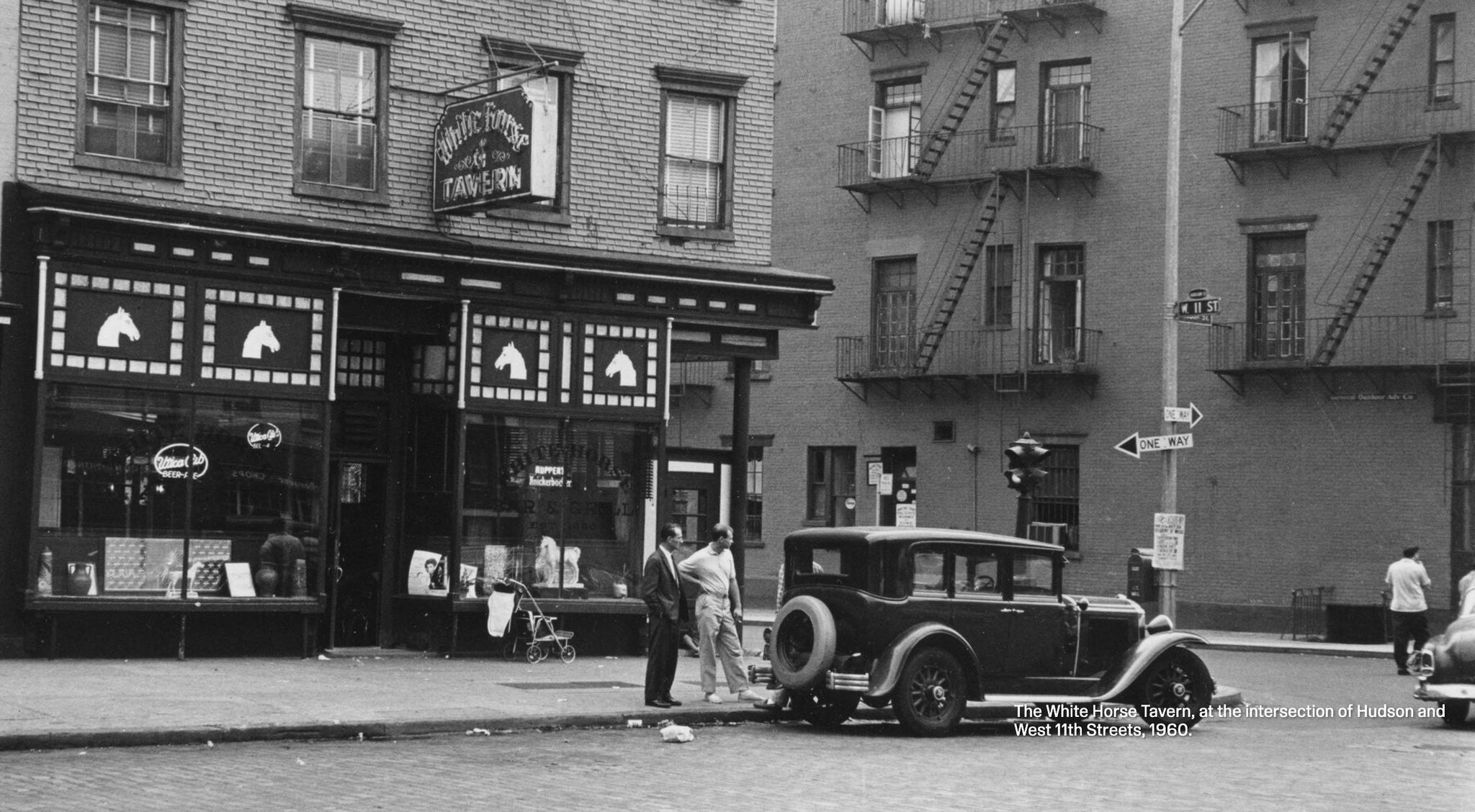
It was this moment that made me realize that the walking-tour format has something unique to offer, something that cannot be realized in the classroom. We weren’t just reading and discussing Jacobs, the sidewalk ballet, and the Greenwich Village street life that seeded it—we were doing so on the very block of Hudson Street where the idea was conceived, the one that contains both the White Horse Tavern, famously depicted by Jacobs as a site of convivial cross-class contact, and Jacob’s own row house at number 555, where she may very well have sat and gazed out the window as she typed out the theory. In other words, we were performing the sidewalk ballet while discussing it. There is something about this act of performance that adds a new dimension to your understanding of the theory, which has been conveyed to you using words but which has to evoke a reality that is essentially bodily. And so, as we recited and pondered Jacobs’s theory in the midst of passersby, bargoers, street people, some of whom listened in and commented, it felt like we were restoring the necessary context to understand what Jacobs was trying to say. Doing it this way provides a richer experience, one that demand that we refuse the separation of the the mind from the body and that we awaken our capacities for movement, for feeling, for imagination.
It was that moment, when everything seemed to come together, that made me think—OK, there’s something here. So I decided to keep going. The result is Battle Tours NYC, which had a soft launch in January and graduated to full-blown website status in March. Right now we are offering the Jane Jacobs tour, built around an imaginative reconstruction of the midcentury Greenwich Village in which Jacobs lived and worked, trying to recover a sense of the historical dynamics that gave rise to her incredibly influential ideas but which may have also served to undermine them. Next up is a walk that explores the cooperative housing dream, which transformed the tenement districts of the far Lower East Side in an attempt to solve a problem which has never been solved in New York—how to provide worthy homes that are affordable to the city’s working class, sheltered from the speculative market, and ask that residents participate actively in the collective management of their own spaces, creating (in the minds of its architects) a microcosm of a cooperative society to come. Many more ideas are in the works, from a social history of Central Park to an imaginative reconstruction of the 1741 conspiracy to how did Bushwick get to be that way?
I invite you to join us on one of these walks. They’re great ways to get out of the house, get off the phone, use your body, encourage contemplation, meet other people, and refuse the deadening speed of contemporary life, welcoming the friction of a city that is increasingly frictionless. As a thank-you to Celestial Pablum readers, you can use the discount code CELESTIAL25 for 25% off our next walk, which takes place on April 25. The normal price for the tours is $75, which reflects the depth of the research, the decades of training and teaching experience that inform it, and (let’s be real) the frightening escalation in the cost of living that is making it harder and harder for people like me, who want to experience and offer an alternative to a world ruled by moneymaking at any cost, to conceive of doing it in places like New York. The reality is that New York is a dramatically unequal city, one that contains significant numbers of people for whom $75 is quite doable and significant numbers of people for whom it is not. For this reason there are reserved a number of sliding-scale spots on each tour for those who want to participate but cannot afford the full price. All you have to do is ask. These realities are part of what the tours are meant to confront and I hope this model can enable broad participation while making it possible for me to keep doing it.
If this all sounds interesting, I hope to see you in the streets. The biggest hurdle I face is simply spreading the word, so if you’re able to tell anyone, whether it’s your stable of social media followers or just one friend, I’m quite grateful. To stay up-to-date on new tours and other goings-on, you can sign up for our newsletter or follow us on Instagram (still weighing whether I am too aged to convincingly appear on TikTok).
We live in a world where the institutional supports for meaningful collective inquiry into the places we love are collapsing. We have to build things that are new. See you outside.